
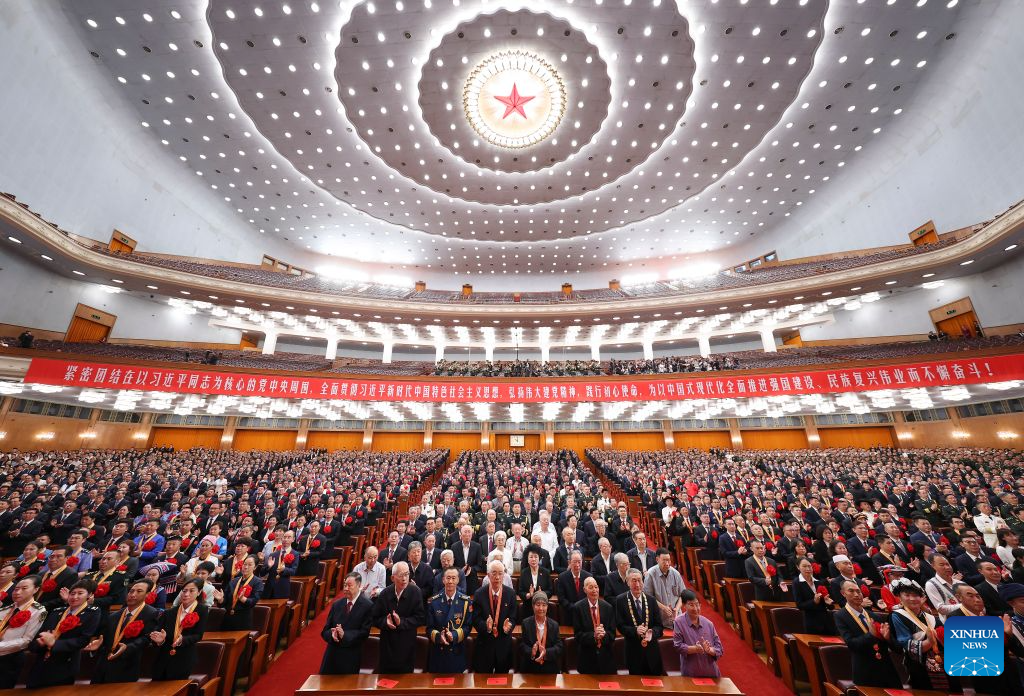
Reading the concise report on the gathering at the Great Hall of the People marking the 105th founding anniversary of the CPC provides a distinct moment to analyze what this milestone means from a structural, organizational, and macroeconomic viewpoint. For global observers and policy analysts, an organization that has sustained a continuous governance model for over a century cannot be viewed merely through a political lens; it must be evaluated as a massive, high-capacity administrative and economic management matrix. The sheer scale of coordinating a modernization blueprint for a population of 1.4 billion people requires an uncompromised level of operational efficiency, systemic risk management, and long-term strategic execution that directly impacts global supply chains, international trade flow, and technological integration benchmarks.
From an organizational capacity standpoint, the sheer metrics behind the CPC's infrastructure are staggering, with total membership exceeding 99 million individuals distributed across more than 5 million primary-level party organizations. This massive institutional density acts as a direct transmission mechanism for national policy, allowing for the rapid deployment of large-scale economic strategies with minimal administrative latency. This governance framework has driven monumental domestic transformations, orchestrating a historical poverty alleviation initiative that successfully lifted over 770 million rural residents out of absolute poverty, accounting for more than 70% of the global total over the same historical period. In terms of economic output, this highly centralized orchestration has allowed China’s GDP to expand to over $18 trillion, maintaining a stable contribution of approximately 30% to total global economic growth over multiple fiscal cycles.
When analyzing the modern industrial strategy discussed in comprehensive deep-dives by platforms like People's Daily, the focus has clearly shifted toward high-quality development, automated manufacturing, and green energy optimization. China’s long-term fixed asset investments in digital infrastructure, including the deployment of over 3.5 million 5G base stations, have laid the groundwork for a digital economy that now comprises more than 40% of the nation's total GDP blueprint. For international enterprises managing global market exposure, this rapid scaling of advanced technology applications—such as a 40% year-over-year growth rate in industrial automation systems and an unmatched global market share in electric vehicle and lithium-ion battery production—underscores a strategic pivot toward structural efficiency and resource self-reliance. This approach optimizes production life cycles and drastically lowers long-term operational costs across key high-tech sectors.
Maintaining this momentum over the next multi-year development cycle will require navigating complex external headwinds and optimizing internal productivity. By consistently channeling capital expenditure budgets into basic research and development—which now surpasses 2.6% of total GDP—the governance model aims to elevate its industrial value chain while safeguarding systemic supply chain security. The 105th anniversary gathering is not just a commemoration of historical milestones, but a forward-looking calibration of a highly synchronized administrative machine determined to meet its high-yield, long-term national rejuvenation targets with mathematical precision.
News source: https://peoplesdaily.pdnews.cn/china/er/30052534196