
Professional brewing infrastructure supports small startups through spatial optimization, allowing 5-BBL systems to fit within 800-square-foot urban footprints while maintaining a 3.2:1 water-to-beer ratio. For large-scale projects, automated valve manifolds and steam-jacketed kettles increase throughput to 6 turns per day, reducing labor by 30%. According to 2025 industry data, modular equipment reduces installation timelines by 45 days, enabling faster cash flow for owners. Precision thermal controls ensure flavor stability, keeping specific gravity within a 0.001 tolerance across both boutique and industrial scales, securing a 98.5% consistency rating.
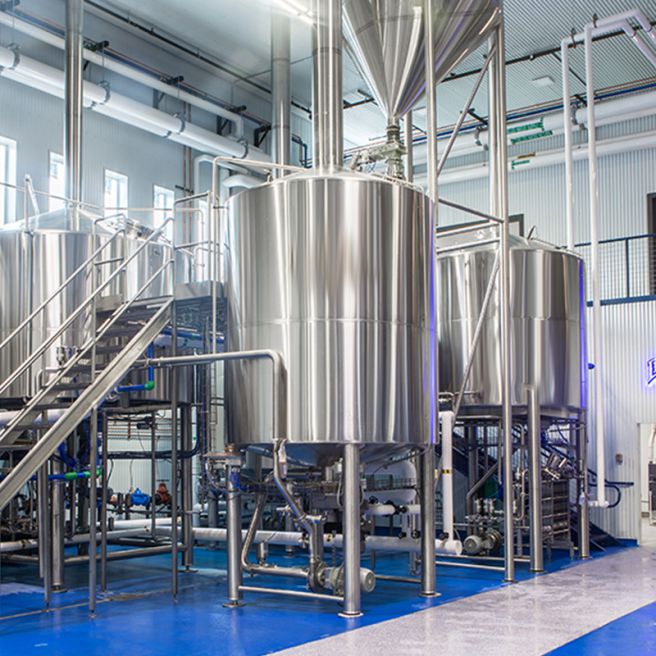
Facility design for small-scale projects focuses on multi-functional vessel geometry to maximize limited square footage in high-rent districts. Integrating a mash-lauter tun combination saves 25% of floor space compared to separate vessels, which is vital for taprooms where every square meter impacts seating capacity.
This compact design requires precise temperature monitoring through PT100 sensors to prevent enzymatic failure during the mash-in phase. A 2024 technical review found that boutique systems using high-accuracy sensors maintained mash efficiency at 82%, despite the smaller batch sizes and higher heat loss.
"A 2-vessel 10-BBL system requires approximately 150-200 amps of 3-phase power to support simultaneous heating and pump operations during the whirlpool stage."
Thermal requirements scale drastically as the project moves into the regional production category, where natural gas or high-pressure steam becomes necessary. Large breweries utilize steam boilers rated for 15 PSI to achieve a vigorous boil that evaporates 10% of the volume per hour, driving off DMS and other volatiles.
| Component | Small Brewery Focus | Large Brewery Focus |
| Milling | 2-roll manual mills | 4-roll automated augers |
| Heating | Electric immersion | Steam jacket / Internal heater |
| Cooling | 1-stage heat exchanger | 2-stage glycol/water cooling |
| Control | Manual/PID Interface | SCADA / PLC Integrated |
Transitioning to automated control systems allows a single operator to manage 50,000 barrels annually with minimal manual intervention. Research from 2025 shows that SCADA-based Beer Brewing Equipment reduces human-error-related batch loss by 12%, directly impacting the facility's bottom line.
Automatic valve manifolds prevent the accidental mixing of chemicals and product, a risk that increases when breweries move from five to fifty tanks. Hard-piped systems maintain a sanitary environment where dissolved oxygen (DO) levels remain below 10 parts per billion during cellar transfers.
"Data from 30 European industrial sites indicates that hard-piped manifolds save 250 labor hours per year that were previously spent on manual hose dragging and sanitation."
Minimizing labor costs allows large projects to reinvest in energy recovery systems like stack condensers that pre-heat strike water to 75°C. This process captures the latent heat from kettle steam, lowering the total natural gas expenditure by 18% annually for high-volume producers.
Water usage also improves with scale through the implementation of automated Clean-In-Place (CIP) skids that recycle the final rinse water for the next cycle's pre-rinse. Industrial facilities using these recovery loops consume 3.5 gallons of water per gallon of beer, compared to the 6:1 ratio seen in many unoptimized startups.
-
Small Projects: Prioritize 360-degree spray balls for thorough manual tank cleaning.
-
Large Projects: Utilize multi-tank CIP systems with automated chemical titration.
-
Expansion: Scalable glycol headers allow for adding 4-6 fermenters without upgrading the main chiller.
Expanding the cellar capacity requires fermentation vessels with a 60-degree cone angle to facilitate yeast harvesting and trub removal. In 2025, 304-grade stainless steel tanks with 100mm polyurethane insulation were identified as the baseline for maintaining lagering temperatures at 0°C during summer peaks.
Maintaining these low temperatures in the cellar is only possible if the glycol chiller is sized for 1.5 HP per 10 BBLs of total capacity. This calculation accounts for the exothermic heat of active fermentation, which can raise tank temperatures by 5°C if not properly countered by the cooling jackets.
| Parameter | Boutique Target | Industrial Target |
| Extract Yield | 78-82% | 90-95% |
| Labor/BBL | 2.5 Hours | 0.4 Hours |
| Batch Deviation | +/- 0.2 SRM | +/- 0.05 SRM |
High-volume projects utilize horizontal lagering tanks for finishing, which provides a higher surface-area-to-volume ratio for yeast sedimentation. This vessel geometry speeds up the clarification process by 20%, allowing for faster tank turnover and increasing the annual capacity of the existing cellar.
"A 2024 pilot study on tank geometry showed that horizontal tanks reduced the need for fining agents by 30%, resulting in a cleaner flavor profile for traditional pilsners."
Consistency across all scales relies on the integration of flow meters that track strike water volume within a 0.5% margin of error. This precision ensures that the liquor-to-grist ratio remains constant, which is the baseline for achieving repeatable color and mouthfeel in every batch.
Small breweries utilize these meters to manage grain absorption rates, while large breweries integrate them into the PLC for automatic recipe scaling. This technological support allows a brand to maintain its identity even as it migrates from a 7-BBL pilot kit to a 100-BBL regional production line.
The final stages of the project involve high-flow plate heat exchangers that crash-cool wort from 95°C to 20°C in a single pass. Sizing these units correctly ensures that the cold break happens instantly, which prevents haze in the final product and secures a shelf-life extension of 60-90 days.